
Our departments
Sunseed is a multifaceted project developing and experimenting with various topics from non-formal education, sustainability, biodiversity and self-sufficiency. Our departments are organised into three teams to cover all fields.
Each department runs different activities. As an ESC volunteer, intern or assistant you can join one department to master a specific skill or experiment in different departments to broaden your learning experience.

Practical
Organic Gardens
Sustainable Living
Ecosystem Restoration

Technical
Appropriate Technology
Eco-maintenance

Office
Education
Communication
Administration


Organic gardens
Syntropic agroforestry and permaculture in action
The Organic Gardens department uses techniques that work with nature to create a regenerative ecosystem and aim for food abundance. Sunseed grows its own organic fruits and some vegetables, reducing food miles whilst promoting practical self-sufficiency. We are still in a regenerative phase and receive a weekly vegetable order from a local farmer.
Composting
Compost is a vital part of the nutrition cycle of food production. You can master the art preparing the new compost - through hot compost process, layering different materials. Another job is to take care of the process, supervising the proportions, mixing compost and adding water. Upcycle our food waste from a veggie based diet.
Seeding and transplanting
You will be preparing the substrate to use in the trays, seeding according to the seasonal and biodynamic calendar, taking care of the seedlings/watering the greenhouse, transplanting them once they are ready, following companion planting and experimenting with different arrangements of the plants.
Seedbank management
Supervise our seed bank! The process starts with the research, selecting the species typical for our region, (climate condition, disease immunity, good fruits and yield), and saving the seeds through cleaning, drying and packaging (labeling species, date, origin). The second part includes updating and organising the seed bank. The third part consists of planting selected seeds, taking care of the seedlings, transplanting and collecting fruits.
Syntropic agroforestry
Symbiotic relationships between plants (strata and roots). Harvesting the energy of the sun (photosynthesis) in an intensive way by high density plantations and intensive pruning to transport that energy on the soil. Compost happens in situ, naturally.
Irrigation
Keep the gardens flourishing and work with either acequia (traditional flood system), drip irrigation or manual watering with a hose. Maintain the acequia, clean the line and irrigation channels, insulate them with clay.
Maintenance
The gardens need constant care and love. Help managing the beds, chopping and dropping, weeding, adding mulching, compost and manure, installing and cleaning the irrigation pipes, building shade and support structures, seeding green biomass and tidying the toolshed.
Experimentation and research
We are always improving our working system and find new ideas for our gardens. A lot of research can be done about techniques, methods and tools to achieve a flourishing and healthy garden.
Sustainable Living
Organising off-grid life
From homemade bread and jam to natural cosmetics and cleaning products, the SL department demonstrates the use of local, sustainable products. Ensuring the smooth running of Sunseed’s low impact lifestyle, SL maintains our vegetarian and non-chemical policy.


Bread making
Discover the art of bread baking with home-made sourdough. Through the theory of fermentation, different recipes for different flours, kneading the dough and mastering Sunseed oven you can become The Sunseed Baker.
Making cosmetics
Natural cosmetics are an important part of Sunseed's sustainability as our wastewater system is directly connected to the gardens - everything we put on our skins will end up in our veggies. Learn how to produce natural products and make your own experiments!
Kefir, kombucha & ferments
Learn how to produce your own probiotic drinks and foods rich in good bacterias to boost your immune system and share it with the whole community.
Pickling and preserving
We produce our own jams, salsa, chutneys, compotes or pickled goods. Help SL department to preserve food using local, seasonal ingredients. Get into the game of making kimchi, Sauerkraut and all kinds of other delicious things.
Medicinal garden
One of Sunseed gardens is being taken care by SL department for the purposes of providing medicinal plants for cosmetics, medicine and infusions. Tasks include pruning, weeding, planting, preparing beds, discovering companion planting.
Nutrition focalizer
Food is an important part of Sunseed life. Key tasks for these role are: promoting vegetarian diet with good nutritional values balance, demonstrating and encouraging solar cooking, foraging and promoting the use of local and wild edible plants, making sure that food store supplies are stock up.
Market organisation
One of the ways to promote the project is through local artisanal markets. You can coordinate the work of different departments to prepare items for the Sunseed stall, managing the logistics and being the promoter during the events.


Ecosystem Restoration
Drylands Stewardship
Through observation of natural ecosystems the Drylands Management department aims to understand the processes of desertification. We experiment with methods to combat land degradation, improve soil quality, restore the local vegetation, and implement innovative water management technologies.
Seed bank maintenance
Enriching our seed bank with wild seeds collected, processed and labelled with our very hands, from many varieties of autochthonous +/ endemic plants from the mountain and valley.
Plant nursery care
Researching and executing pre-treatments of selected seeds from our seed bank. Planting from seed or propagation. Experimenting with homemade soil mix's. Continuous observation, watering and care of the nursery plants.
Compost toilet maintenance
We oversee the working conditions and dates of opening and closing of our double and triple vault Vietnamese compost toilets. Managing the carbon/nitrogen ratios within the current chambers by experimenting with compostable materials. Usage of the processed humanure in our restoration projects.
Arboretum maintenance
Our arboretum requires winter pruning, summer mulching, and year-round irrigation of the smaller trees. Seeds are collected and fruits are harvested throughout the year. Path maintenance.
Land stewardship
Responsibly and sustainably foraging seed, flower, leaf, root and fruit from the river and mountains. Taking care of the soil, flora and fauna of the lands. Reconnecting to land and place, learning from and with the land.
Drylands irrigation
Irrigation of our restoration and regeneration plots is oftentimes a challenge, we invite traditional and innovative techniques to facilitate water harnessing in semi-arid regions. Here we already experiment with systems of sustainable water catchment like swales, half-moons and microbasins.
Research
We are always open to researchers, particularly of: semi-arid biomes, rural andalucian ethnography, traditional crafts, relationality and kinship, decolonial methodologies in environmental studies, water retention techniques and soil fertility. Get in touch with your area of study to conduct your research here.
Appropriate Technology
Low impact, off-grid systems
The Appropriate Technology department promotes innovation in the use of available technologies to reduce our impact on the environment. AT maintains our solar and water systems, whilst focusing on innovating and researching alternative energy sources and creative options such as bicycle-powered machines.


Photovoltaic system
Help taking care of our solar panel system by checking the energy levels, doing maintenance of the batteries and the panels.
Electricity
Some of our electric systems have been developed over time and became unnecessarily complicated. Help us with the rewiring or work on a new design.
Experimentation and research
We are always exploring new low technologies and alternative solutions, like our own biogas production or building a bike powered blender. Help with researching past projects from our archives, bringing them back alive or implementing new ideas.
Hot water system
Join the AT team for the maintenance and supervision of the system that allows us to use solar energy to have hot showers and gain the understanding of our off-grid installations.
Waterline and Ram Pump
Discover the 'acequia' - a traditional watering system and the mechanics of the hydraulic ram pump. Make sure that the flow is steady on the whole length so the village can enjoy the water in their taps. Work with the village acequiero to manage the system.


Eco-maintenance
Low impact, local materials
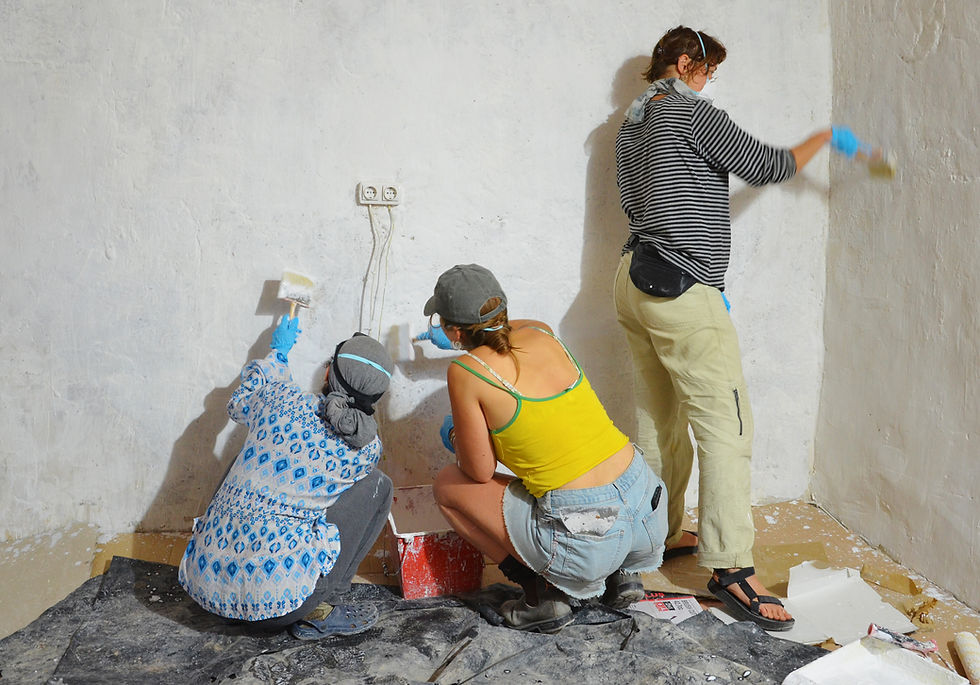
The Eco-maintenance department demonstrates ecologically-friendly building techniques and natural alternatives to dangerous modern construction practices. A mix of traditional and local ecological building methods and materials are used. The department is responsible for not only construction, but mostly maintenance.
Building maintenance
Our traditional Andalucian buildings need a lot of care and attention. Learn how to use natural materials to keep walls and roofs in a good shape. We work with yeso, lime wash, caña, reeds and cob.
Carpentry
Help us fix broken or build new furniture, structures and other materials in the project. Find ways to reuse materials, use local materials and make things more practical. Experiment with what nature gives us, for example the abundance of caña reed, the gypsum rocks or Pita wood.
Shaping spaces
Join the team to develop and rethink how we design, build, construct and maintain our spaces. What's the best way to build fences, bridges or roofs?
Workshop care
At Sunseed we have a beautiful workshop space with power tools, hand tools, and many recycled materials. Help keep the workshop organised, maintained and repair or build new tools.
Waste Water System
The Eco-Maintenance Department is responsible for the ongoing maintenance and care of Sunseed's wastewater system. Regular inspections, cleaning, and repairs ensure that greywater is safely treated and reused, protecting both the environment and the health of the community.
After treatment, the water is distributed through an underground irrigation system that runs beneath the gardens. This system allows the treated greywater to be used efficiently, and the Gardens Team relies on it to irrigate vegetables and other crops, reducing the demand for fresh water while supporting sustainable food production.
Maintaining this system is an essential part of the department's responsibilities, helping to prevent blockages, unpleasant odours, and contamination while ensuring the reliable operation of one of Sunseed's key ecological infrastructures.
Education
Non-formal learning
A big part of Sunseed's mission is to provide a flexible and inspiring learning process. Provide, support and install different tools, methods and spaces for experiential and experimental education. From hosting educational activities in the community, Erasmus programs and Youth Exchanges, to establishing contacts with universities, organising transformative courses and visits from local schools, the Education department is the engine that keeps Sunseed full of people learning and experiencing sustainability practices.


Internship & ESC supervision
At Sunseed we host many interns from around the world. We are also part of the ESC volunteering program. You go through the recruitment process, supervise the internships and the ESC program and support them in their personal research project. It's an extremely rewarding and valuable experience to support others in their learnings and personal grwoth journey.
Networking
Are you a teacher or a student? Or maybe you know someone who works for a university, Erasmus or an organisation that is a part of a network aligned with our project's mission? Help to establish new links to promote sustainability and create resilience on a local and international level. If you come from Spain, this could be a great opportunity to connect with other like-minded projects interested in learning about sustainable living.
Decolonisation
Investigation into the archives, history of the project and the region. Create formats to talk about decolonial Sunseed like organising a workshop, a blog article, a podcast episode, an Instagram post, a local event. Introduce the project: The 1980s, the original project ‚Green Deserts‘, UK people, and then create a space for critical reflection on the topic. Why are these neo-colonial patterns? How do we approach this topic to be an actively de or anti colonial space? This can and should be uncomfortable.
Educational activities
We offer weekly educational activities for our community. They can be offered by anyone while the Education department supports and guides people in this process. Make sure the activities align with the project, are joined regularly or host them yourself. Ensure that the project maintains a cross-disciplinary approach where all departments can learn from each other.
Mentoring
We have a one-to-one mentoring structure at Sunseed, where everyone who joins the project receives a personal mentor. You select the mentor, become a mentor yourself, and keep adapting the mentoring structure and presentation.
Degrowth & environmental justice
We live in the only oasis in Europe, one of 50 biodiversity hotspots defined by the UN. The river is experiencing an ecocide, overexploited by the intensive olive monocultures. We are surrounded by the biggest accumulation of greenhouses worldwide. Active soil degradation and desertification are the consequences of capital driven mismanagement of land and labour in this area. We have many wild fires in the summer, and floods in the winter. You get to offer presentations, field trips, talks, discussion and reflection spaces around these topics.
Archiving
There has been numerous research and study done in Sunseed. A big part of it is still in analogue version. Develop a methodology of classifying the information, organising and presenting it in a digital format. Develop your own version of a physical archive or 'anarchiving' structure.


Communication
Online and face to face networking
The primary mission of the communication department is to share knowledge, to show current projects and activities, and to promote sustainable lifestyles. Activities range from reaching out to online and local audiences, to communicating internally and managing the recruitment process for co-learning residents.
Become the social media creator of Sunseed. If you enjoy taking photos and videos, content creation, editing and writing, then this will be your palace! Help us maintain our online presence and share some good vibes. Simply follow our social media handover and don't hesitate to propose creative ideas to make it even better! Maybe you even have some online connections, are familiar with social media strategies or know how the algorithms work these days!
Emails & recruitment
As the face of communication you are the first person people encounter when contacting us. You will be the window to Sunseed, staying in touch with people through email, often answering requests to join the project. The communication department also handles all applications to our co-learning residency program.
Film-making & photography
Videos play an important role in modern online communication. Pick the subject that you are most passionate about, pick the format and share it the way you like it! Many documentaries have been filmed at and about Sunseed, maybe you want to find your own perspective and story about it through film.
We have a camera at Sunseed that is ready to be used by you! Take some creative photos and capture different angles of Sunseed. A good photo can tell great stories.
Campaigning
The local aquifer Aguas is dramatically over-exploited by massive intensive monoculture olive plantations. Help to raise awareness about the ecocide by connecting with local platforms, organising activist actions and producing educational content.
Newsletter
Direct email contact is the most efficient way to maintain a valuable connection with our audience and past members. Take part in the planning, selection and creation of the content to keep our many thousand subscribers updated! We send out a monthly newsletter with little stories, pictures and open calls/positions.
Journalism & website
Do you like creative writing? Are you curious about the world around you and feel the importance of sharing your experiences with others? Help us documenting Sunseed's experiments, events and alternative solutions by writing blog posts for our website. You're also in charge of updating our website with current news, open positions and stories. Reach out to magazines, blogs or other initiatives around us to get involved and write something for them. We have been featured in many publications and you could be the next storyteller! We also have a small podcast series that you're welcome to continue.
Design
Are you skilled or curious about graphic design? Help to design informative and educational content following our identity brand guide. Graphic design goes beyond aesthetics and asks you to collect, identify and share information in an comprehensive and holistic way. Create flyers, posters, Instagram posts, books, signs, labels, forms and more.
We always work on improving our current structures and ways of communication. Find creative solutions for challenges and design social processes that meet our community needs and values here at Sunseed at its core.
Administration
Financial & legal backbone of Sunseed
The Administration department at Sunseed ensures the financial health, legal compliance, and operational transparency of the entire project. It acts as the central hub connecting on-site staff, external advisors, and the community, managing accounts, legal documents, and payments while promoting open communication and shared responsibility across all areas.


Financial accounting & weekly reporting
The department oversees the internal accounting process on a weekly basis, working collaboratively with coordinators and community members. It tracks every financial movement—making payments to staff and suppliers and collecting payments from residents, interns, and visitors—ensuring all transactions are properly recorded. This rigorous approach guarantees accuracy, traceability, and full transparency in all money-related matters.
Budgeting, forecasting & financial planning
The department analyses income and expenditure patterns to identify areas needing additional resources. It prepares financial reviews and annual summaries to keep the community well-informed. A detailed forecast at the start of each year guides economic decisions, enabling Sunseed to plan sustainably and respond effectively to changing financial circumstances.
Legal compliance & document management
From insurance policies and tax filings to deeds, contracts, and local agreements, the department manages Sunseed's entire legal portfolio. It handles responsibilities toward both UK and Spanish authorities, and keeps all land arrangements and permits up to date. This proactive legal oversight prevents compliance issues and protects the project's long-term stability.
Payments, reimbursements & supplier coordination
The department manages all outgoing payments, including invoices to suppliers and reimbursements to staff who have paid out of pocket. It ensures that every payment—whether for bills, tickets, or services—is processed promptly and accurately. This meticulous coordination maintains healthy cash flow and strengthens relationships with external partners.
Systems, training & transparent workflows
Using digital tools like Trello, the department designs efficient administrative systems and regularly updates its folders to ensure both effectiveness and openness. It actively trains community members in administrative tasks, empowering them to understand and participate in financial processes. This commitment to transparency fosters trust, shared knowledge, and collective responsibility throughout Sunseed.