

Internships at Sunseed
Gain valuable practical skills
Internships at Sunseed are a great opportunity to gain some hands-on experience within different areas of sustainability. This ranges from agro-ecology, communication, ecosystem restoration, environmental education, sustainable living skills or appropriate technology. We provide the space and support for self-driven education.
Our internships fall into two categories, General and Research internships. Below you can find more information about them!
As an intern you are free to develop your own research project alongside the daily departmental tasks. You will receive a supervisor and a personal mentor to guide you through this process. In general, an internship at Sunseed is for you to explore and turn your theoretical research into hands-on practice.
The ideal candidate for our internships would be comfortable with, or ready to explore, the balance between communal living, professional responsibilities, and environmental integrity.
You will be working in on of our eight departments.

1.
Secure your funds
Find out if your university has available funds to finance your traineeship at Sunseed. If not, find and alternative funding. Typically our internships are funded by Erasmus+.
2.
Plan your internship
After having read about our departments, select a department, an internship model which corresponds with your wishes or share you ideas with us concerning a tailored program.
3.
Apply
Prepare your CV and fill out our application form. Select one department you want to work in and tell us what you would like to learn or a project you want to develop. We will get back to you as soon as possible.
4.
Interview
After reading your application, we will have an interview with you. The community will then collectively decide on the recruitment.
Our general internship is the chance for you to explore in depth one of our departments and learn from our daily tasks and long-term projects. You don't need to bring a specific research project from university or be connected to a university at all.
You will learn from your department supervisor and get to develop a project for the department and your personal research. You will contribute to the running of everyday life, taking on responsibilities to assure a supportive communal and low-impact environment.
Please choose a department you'd like to do your general internship in:
General internship
Our research internship allows you to bring your academic skills to the ground and conduct a community based research project with us. Have a look at the department description and either before or during your internship come up with a specific investigation proposal. Your personal research interests can be adjusted to our current departmental projects, while keeping in mind the objective of place-based and impact-bound knowledge creation. You may also bring a research project that you’re already working on.
You will learn from your department supervisor who then guides you through your research project. Research interns are expected to be self driven investigators. You will contribute to the running of everyday life, taking on responsibilities to assure a supportive communal and low-impact environment.
Please choose a department you'd like to do your research internship in:
Research internship

Your internship
at Sunseed
6 h of work per day, 5 days a week
Personal mentoring sessions
Internship supervisor
2 days of holiday
per month
Free food and accommodation
Project development support
Prices
Our internships are typically funded by the Erasmus+ program as part of your university studies. Please check with your university's internships and mobility department if there are funds available to carry out your internship with us.
To help keep Sunseed as a project running and accessible to everyone, we use a “bottle” pricing system. This means the amount you pay depends on your financial situation.
This system is based on shared responsibility and individual circumstances. The minimum contribution is 400€ per month, which covers your basic costs, including accommodation and three meals a day.
If you receive funding from a university or organisation, a higher contribution (or ‘bottle’) helps support both the project and other participants who have a lower budget. If you don’t have enough funding or any, a lower pricing option may be more suitable for you.
We ask you to choose the bottle according to the amount you receive for funding or what you can afford if you don’t have funding. After that we decide together on the right contribution through a conversation.
Bottle system:

1. Bottle
You can contribute 750€ per month (Paying 22€+ a day). This should leave you with sufficient money to cover extra expenses, such as travel and pocket money.
2. Bottle
You can contribute 650-700€ per month (Paying 17€ a day). This should leave you with sufficient money to cover extra expenses, such as travel and pocket money.
3. Bottle
You can contribute 400-600€ per month (Paying 13€ a day). This should leave you with sufficient money to cover extra expenses, such as travel and pocket money.
This is always an open conversation, and please don't hesitate to reach out if you any questions!
What does your contribution cover?
Organic food
From Monday to Friday we serve three vegetarian meals a day. Food on the weekends is self-organised with the use of our supplies. 15-20% of the food comes from our gardens. The rest is bought from local farmers and regional ecological producers.
Educational activities
Our team offers a range of activities depending on the departments' needs. You can get involved with gardening, eco-maintenance, drylands management and more. You can also take on a personal project if you have a specific skill.
Accommodation & maintenance
Your payment covers accommodation in our dorms, clean bed sheets, the use of natural cosmetics and administration costs. Our houses are maintained in the traditional Andalucian style. While reusing as many materials as possible, we still have to buy some from time to time.
Fixed costs
To provide an educational experience for people from around the world we have many hidden costs - rent, insurance, taxes, website hosting, phones, internet, car maintenance, staff reimbursement and more. Your contribution will help us to continue running Sunseed in the long-term.
Research & projects by our past interns
As an intern you either work on your self-conducted research project or you create a small personal project at Sunseed. Have a look at what our previous interns were researching and experimenting with:
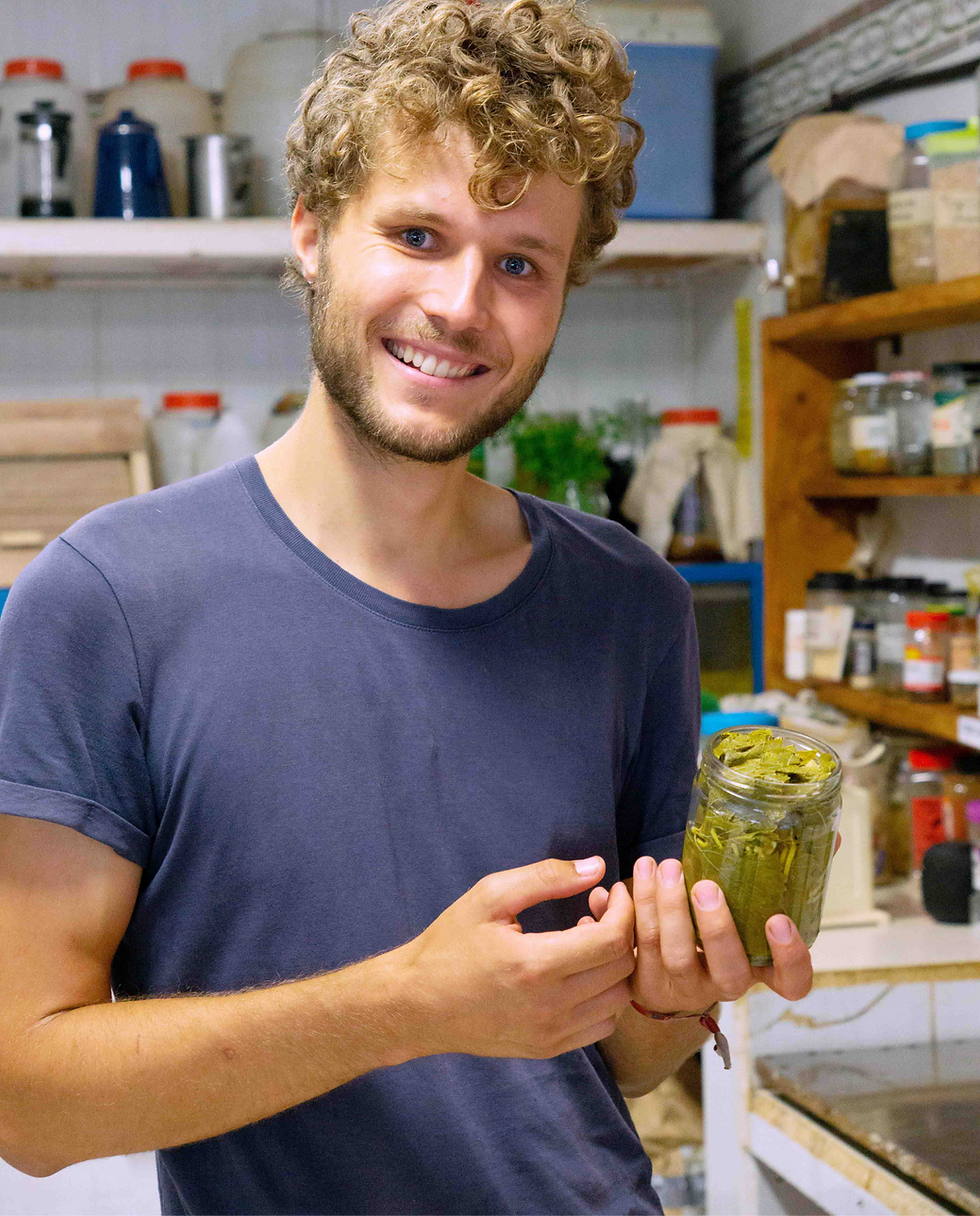


Organic Gardens, 2025
Raphael Prautzsch
„I spent three months at Sunseed as a gardens intern. During this time, I carried out a small project that connected to my academic background. Before joining Sunseed, I had written my Bachelor Thesis on the sustainability of different value chains for pickled vine leaves. Since the vine in Sunseed grows organically, it offers the perfect opportunity to explore pickling vine leaves without the concerns often associated with conventionally grown leaves — such as pesticide residues. Some commercially available products have been found to contain pesticide residues exceeding legal limits, or even substances that are not approved for use in the EU at all (Hayar et al., 2021; Ökotest, 2023)
You can use pickled vine leaves as a pizza topping, in a salad or pesto, or in the traditional way by filling them with grains (typically rice), lentils or soy chunks. Vine leaves are not only tasty but also rich in valuable nutrients: fibre, organic acids, vitamins (A, C, K), minerals (calcium, iron, magnesium), and bioactive compounds like polyphenols and phytosterols. These give them antioxidant, antimicrobial, and anti-inflammatory properties. A key part of sustainable food systems is using land efficiently — what’s called ecological intensification or multiple use of agricultural areas. Vine leaves fit perfectly into this idea because they provide an additional product alongside the grapes.“


Communication & Sustainable Living, 2025
Clara Milla
„I am Clara, a former Communication & Sustainable Living intern. I just had finished my Bachelor in Arts in Bozen, South Tyrol. For my thesis, I started an extensive research about the sculptural potential of fibers, both organic and synthetic. I was lucky to be at Sunseed in a period of immense vegetative abundance. The valley was filled with Poppeys, Marigolds, Camomilles and many more plants waiting to be harvested and observed. As we harvested those plants I always took one of the flowers and leaves aside to press them. My idea was to create an extended Herbarium of the plant diversity, found in the Valley. I wanted to experience a new context of working as a graphic designer ( more environmental and social versus capitalistic or commercial) and to follow my emerging interest in herbology and its role in my artistic practice.
I wanted to combine the traditional scientific Herbarium with a more mythological approach to plants. The Herbarium should not only describe the single plants, their anatomy and their properties, but to give also space to their essence,
their symbiotic relationships and to the magic they carry. One day I dove deep into the tree Eucalyptus and its historic, economic and ecological significance for the south of Europe. It fuelled me to raise my and others awareness of the
actual ecological footprint of paper and to unmask the story of paper, as the most sustainable materials of all. Due to lack of time, I couldn’t finish the project, but I held an educational activity at Sunseed in which we scooped paper out of old paper scarps as well as fibres from Jeans, and gave space for a critical reflection about eucalyptus farms and its impact on the environment. I then took some of the scooped papers and bound small sketch books.“


Organic Gardens, 2025
Leonie Haus
Leonie was an intern in the Organic gardens department. While tending to our many vegetables, herbs and trees she came more in touch with the local gypsum rocks that make up the valley of Los Molinos. Throughout the weeks she crafted a variety of hand braided bracelets and necklaces, often working with the local crystalline gypsum collected in the area. The jewellery was sold in our Sunseed shop and at the local markets.


Appropriate Technology, 2025
Chloé Delpech and Hugo Saigre
„Hey, I’m Chloé, a French student in an engineering school about renewable energy. I did an internship at Sunseed for 3 months in the department of Appropriate Technology. I really enjoyed discovering how to live in a community and learning about what it is to live self-sufficiently in water and electricity.
I did this internship for my engineering school, the objective was to practise and use our engineering knowledge. I’m very interested in Low Tech and want to learn about how to use engineering skills for more sustainable lifestyles. Together with Hugo, another intern from the same school, we had the idea to build a wind turbine, because the electricity of Sunseed is only produced by solar panels which make the community very dependent on the sun.
First, we did some research about how to build a Low Tech wind turbine, then we did a plan and drawing, and we did a list of all the things we needed. We determined the cost of our wind turbine by trying to be as inexpensive as possible and by maximizing the use of recycled materials to be more sustainable. Finally, the day before leaving, we put the wind turbine on the roof of Main House, but we didn’t have time to finish the electrical part. So there is 3 cables with the 3 phases of the current produced, but now we need to plug it to the batteries with an AC/DC converter and
maybe a stabilizer of current and voltage. Thanks to this project, I learned how to make a generator of electricity with copper wires and magnets, and used some tools to build the wind turbine.“
Hugo and Chloé also used a broken bike of Sunseed, reassembled the parts with other recycled materials and connected it to a blender. Now we can blend foods, make hummus and creams, just by using our legs!


Ecosystem Restoration, 2025
Pierre Salvi
Pierre worked on our plot called 'Jacinta‘ where a lot of caña reeds grow. The plant is invasive and grows aggressively along our riverbed threatening the biodiversity as well as becoming a threat during floods. Pierre helped cutting down hundreds of the caña, collecting them and reusing them to build roof structures in Sunseed. They were also used to build fences and paths in the garden. During a workshop with the local Esparto expert the caña sticks were used to braid baskets that we use for collecting herbs and local plants.